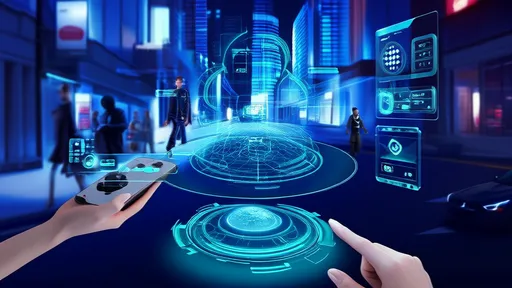
Augmented reality gaming is experiencing a remarkable resurgence, driven by significant advancements in mobile technology and the widespread adoption of AR development platforms like Apple's ARKit and Google's ARCore. These powerful software development kits have democratized AR creation, enabling developers to build more immersive, stable, and interactive experiences than ever before. Unlike the initial wave of AR games that captured global attention a few years prior, the current generation leverages sophisticated environmental understanding, persistent world mapping, and multiplayer capabilities, pushing the boundaries of how we interact with digital content overlayed onto our physical surroundings.
The journey of AR gaming into the mainstream consciousness can arguably be traced back to a single phenomenon. The explosive success of Pokémon GO in 2016 demonstrated the massive, untapped potential of location-based AR experiences. It got millions of people outdoors, exploring their neighborhoods while chasing virtual creatures. However, that first wave was ultimately limited by the technology of its time. It offered a relatively simplistic AR experience, primarily using a device's camera to place a character on a flat surface without truly understanding the geometry of the environment. The magic was in the concept, but the depth of interaction was shallow.
This is where ARKit and ARCore changed the game entirely. Released in 2017, these platforms provided developers with a robust set of tools that were previously unavailable or required immense custom engineering. Their core technologies—simultaneous localization and mapping (SLAM), motion tracking, and environmental understanding—allow a smartphone to comprehend the world in a way it never could before. Your phone is no longer just displaying a image; it understands the floor, walls, tables, and their relationships in three-dimensional space. This fundamental shift is the engine behind the new playstyles, or new ways to play, that are now emerging.
One of the most significant new playstyles enabled by these platforms is the concept of persistent world AR. Earlier AR experiences were ephemeral; the moment you closed the app or moved your phone, the digital object was gone forever. With cloud anchors and persistent cloud storage provided by ARKit and ARCore, digital objects can now be placed in a specific real-world location and remain there for hours, days, or even weeks. You could place a virtual treasure chest in a public park, and another player could discover it days later using their own device, seeing it in exactly the same spot. This creates a shared, persistent layer of reality over our world, blurring the lines between a game session and a persistent world that exists alongside our own.
Building on persistence, multiplayer AR has evolved from a technical dream into a smooth, engaging reality. Developers can now create experiences where multiple users see and interact with the same digital objects and characters in real-time, from their own unique perspectives. This isn't just about seeing the same monster; it's about collaborating tactically in a physical space. Imagine a co-operative game where you and a friend must defend a real-world building from an alien invasion, physically moving around the structure to get better angles for attack. The shared experience, anchored in a common physical location, creates a powerful sense of presence and social connection that traditional screen-based multiplayer games cannot replicate.
Furthermore, the environmental understanding capabilities of these platforms have given rise to more sophisticated and physically believable gameplay. Modern AR games can recognize different surfaces—horizontal, vertical, inclined—and place objects accordingly. A character can jump from the floor onto your sofa, hide behind a real wall, or a virtual ball can realistically bounce down a flight of stairs, ricocheting off the actual walls. This environmental interaction creates a deeper level of immersion and strategy. Games are no longer just superimposed on the world; they are interacting with it in a believable way, respecting its physics and geometry.
The new playstyles also extends beyond traditional game mechanics into narrative and location-based storytelling. Developers are creating AR experiences that turn entire cities into game boards or narrative landscapes. By using GPS data fused with precise local AR tracking, a game can guide you on a walking tour where historical figures appear on street corners, mythical battles unfold in empty lots, and puzzles are solved by investigating real-world landmarks. This fusion of entertainment, education, and physical exploration encourages a deeper engagement with one's environment, transforming mundane locations into stages for adventure and discovery.
Another fascinating area of exploration is in procedural content generation based on real-world data. Instead of developers manually placing every item and enemy, games can now algorithmically generate content based on the environment your phone sees. For instance, a game might use the size and shape of your living room to generate a unique dungeon layout, or populate a public square with challenges and rewards based on the time of day and the number of people present. This means the experience is dynamic and uniquely tailored to the player's immediate physical context, making every play session different.
Of course, this renaissance is not without its challenges. Persistent world AR raises complex questions about digital ownership of physical spaces and requires new models for moderation to prevent digital vandalism or overcrowding. Multiplayer AR demands robust and low-latency networking to keep the shared illusion intact. Furthermore, these advanced experiences are computationally intensive, draining batteries and requiring relatively modern hardware, which can limit the potential audience. Developers must cleverly design around these constraints to create accessible yet groundbreaking experiences.
Looking ahead, the future of AR gaming is intrinsically linked to the evolution of wearable technology. While smartphones are the current gateway, the eventual widespread adoption of AR glasses will unlock the ultimate expression of these new playstyles. Imagine hands-free interaction, a permanent and seamless overlay of the digital onto the physical, and even more profound social and collaborative experiences. The foundational work being done today with ARKit and ARCore on mobile is essentially building the language and design principles for the immersive AR experiences of tomorrow.
In conclusion, AR gaming is not just back; it has matured. The initial novelty has been replaced by substance, depth, and innovation. Powered by the sophisticated capabilities of ARKit and ARCore, developers are moving beyond simple overlays to create deeply interactive, socially connected, and environmentally aware experiences. The new playstyles—persistent worlds, shared multiplayer adventures, and narratives woven into our cities—are demonstrating that the true potential of AR is to not just augment our reality, but to enrich it, turning the entire world into a canvas for play, discovery, and shared human experience.

By /Aug 26, 2025

By /Aug 26, 2025

By /Aug 26, 2025

By /Aug 26, 2025

By /Aug 26, 2025

By /Aug 26, 2025

By /Aug 26, 2025

By /Aug 26, 2025

By /Aug 26, 2025

By /Aug 26, 2025
By /Aug 26, 2025

By /Aug 26, 2025

By /Aug 26, 2025

By /Aug 26, 2025

By /Aug 26, 2025
By /Aug 26, 2025

By /Aug 26, 2025
By /Aug 26, 2025
By /Aug 26, 2025

By /Aug 26, 2025
